
Use case
Training, Simulation
Industry
Defense
Solutions
Unity Industry, Unity Asset Transformer, Essential Success
Impact
Accelerated development time, improved scalability, cross-platform deployment
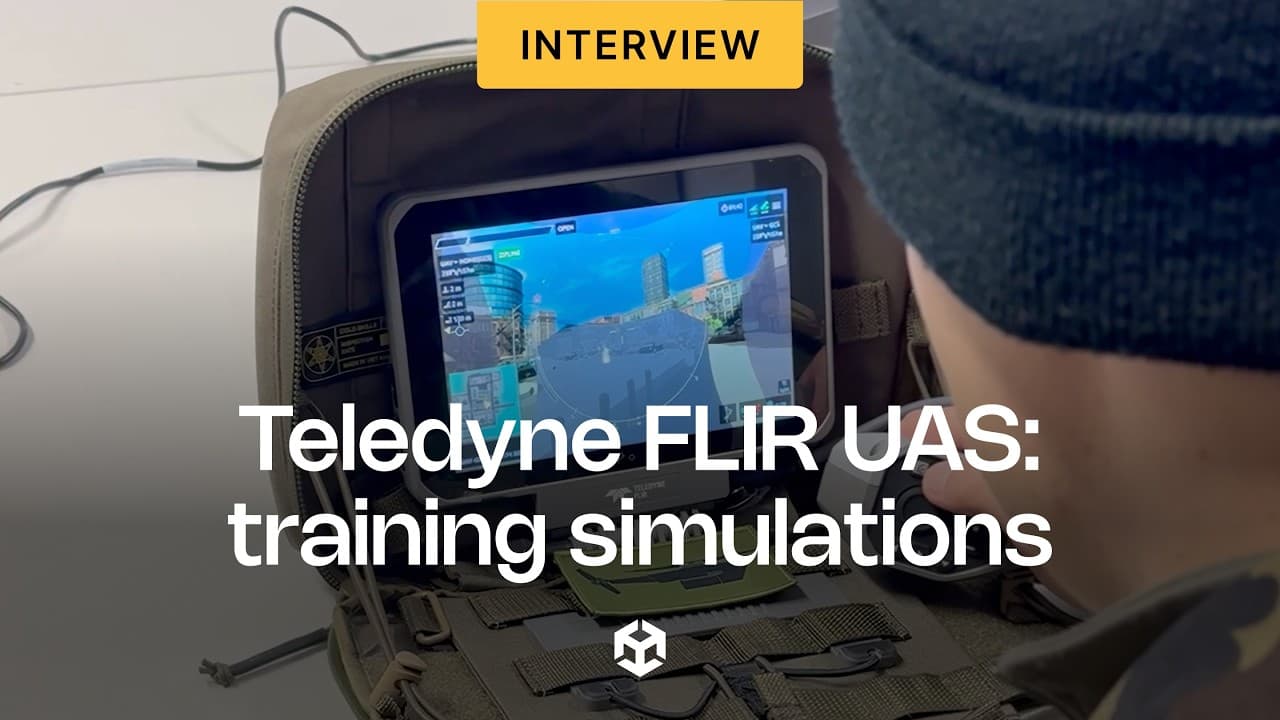
Tom Lund, Director of Simulation Solutions at Teledyne FLIR UAS, discusses how his team has built a scalable training simulation platform suitable for field deployment. Discover how Tom discovered Unity, and how (and why) Teledyne FLIR UAS uses Unity to create their training simulation platform.
Transcript
Introduction to Teledyne FLIR UAS's simulation journey
My name is Tom Lund, and I'm the Director of Simulation Solutions at Teledyne FLIR UAS in Norway. I spent 21 years in the military in the Norwegian Air Force as a pilot, so I was a user of simulators.
When I was still in the Military using simulators, we had the F-16 simulator in Norway, it was a $120 million behemoth, which was great for what it did, but any change we needed to make would take months and millions of dollars to complete. I saw the opportunity then that the gaming industry is doing a lot of this stuff and they're doing it better.
When I started at Teledyne we had the need for a simulator for our product back then, and all our developers were busy developing the software and for the system itself so I said well, I can make a prototype. It became my job eventually!
Why Unity was the perfect fit
For the Black Hornet 4, that needed to be embedded on a fairly low end Android platform. I knew that the majority of mobile games were developed on Unity. This told me that, you know, this is probably a better fit for our Android platform. Also from everything I could read, it was better suited for lower end platforms. I felt that I would get a better result with Unity.
For me, not being a seasoned developer, not knowing C++, not knowing C-sharp, I knew a little bit about programming, but I didn't really have a lot of skill within any particular language. So I knew if I'm going to learn a language, C-Sharp and Unity would probably be much easier for me.
A lot of people think that military simulation will require bespoke software costing millions of dollars and be very advanced. I saw the opportunity that the gaming industry is doing a lot of this stuff and they're doing it better. You don't necessarily need to be 100% accurate on everything. The fidelity doesn't need to be up there to get the training that you need for a lot of things. So when we started developing our simulator, a 3D engine was the obvious choice.
The vision for a Unified Simulation Architecture
This last year, 2025, we started a new project where we are expanding. We're not only making a simulator for our products in Norway, we are making a unified simulator architecture for various platforms within the greater Teledyne FLIR defense. So we have other unmanned vehicles; air, ground. We have sensors. We have a lot of things that require simulation. It's not wise to make a simulator in silos, doing things separately and piecemeal. We want to make one architecture, one image generator, one 3D world with missions and maps and entities and so on, that can be deployed or used on all the systems that we make. That just makes sense, right?
That means we also have to make it communicate with all these different platforms and deploy on whatever they need to deploy on. So the ability to develop once and build for everything - that is huge.
Accelerating innovation with Unity's support
Right now we're a fairly small team and we have to make something that is fairly easy to maintain but can be built on as we grow. So we are just laying the foundation for what we're hoping will become the go-to unified simulation architecture for many of our products.
Being a small team, the consultant services from Unity helps us a lot. Unity was able to sit down with us for a week. We talked about what we need and how we envisioned it. And we got a report back a few weeks later, which outlined Unity's suggestions on how to make this. It has helped tremendously.
We've also used accelerators to help us out, since we are a small team, which is also very valuable. It definitely speeds up the process. And we just recently also signed up for Essential Success. So we're going to use that to help with specific milestones along the way. We have big goals. We have many milestones. We are a smaller team. We have a big vision for what we want to do with our simulation. We need resources to do that.
The first time I tried out Unity Asset Transformer, it was the speed and ease of taking a CAD model and getting a ready-made prefab that I could use. Within 15 minutes of downloading the package and getting the CAD model in there, I had a ready-made prefab that I could use. Which was pretty awesome.
The biggest benefit for us of using Unity is the ease of development, the way it helps us - acting as the third member of our team. It helps us accelerate development, to make things that are really cool. All that you wouldn't think possible with a small team and in such a short time, to get from where we were just having an idea six months ago. To have a product now that is almost ready to deploy to customers and ready to be used in development in a matter of six months. That is solely due to the power and strength of Unity and Unity support.
This transcript has been lightly editorialized for readability.


